Agents need training environments that include infrastructure operations, customer context, incidents, and long-term ownership.
2
Production infrastructure work involves distributed failures, deployments, scaling, cost controls, and live traffic, which a single-node code sandbox cannot reproduce.
3
Emulated is building high-fidelity environments that provision real infrastructure and eventually model whole companies.
Summary
Joseph Wang argues that agents will only become reliable autonomous software engineers if their training data includes the difficult work around a codebase. Existing coding benchmarks usually ask an agent to modify code over many turns, but they leave out customer conversations, operational ownership, deployment failures, infrastructure provisioning, and incidents that unfold over months or years. Emulated puts software companies into containerized and multi-node environments where agents must handle network failures, data corruption, clock skew, rolling deployments, resource provisioning, authentication, billing, telemetry, and live traffic. Wang is candid that even these environments do not fully reproduce production. Real infrastructure takes hours to start, costs money, and still has a sim-to-real gap without real customer traffic and scale-dependent failures. The company starts with infrastructure because its founders have domain expertise there and because infrastructure products have clearer operational requirements. Its longer-term goal is to emulate entire companies with much higher fidelity.
Long-horizon agent work needs data beyond code edits
Wang frames the talk around agents doing useful work for longer periods with little supervision. Current coding benchmarks give an agent a large task and let it produce a code change over 50 to 100 turns, but that is only part of an engineer's job. The missing work includes understanding customer problems, comparing approaches, performance testing, and owning the infrastructure around a codebase over months and years. Emulated treats this missing operational context as a data problem. The company puts software engineering companies into environments with projects, incidents, and customer conversations so agents learn the work surrounding the code.
Infrastructure failures expose a model capability gap
Wang and his co-founder come from network infrastructure, distributed databases, and sandbox infrastructure. They saw that mission-critical systems require reasoning about architecture and system design at scale and over time. Wang contrasts this with agents that handle application-layer tasks well but struggle with infrastructure questions such as MVCC on a database engine and the corruption issues it can cause. His explanation is that model capability often reflects the quality and coverage of the data available for training. If the data excludes infrastructure operations, the agent will have a corresponding gap.
A production task includes organizational and operational context
Emulated's environments include projects, incidents, and customer conversations alongside the source code. Agents must deal with failures that appear at scale, including network failures between distributed nodes, data corruption, and clock skew. They also have to reason about distributed-cluster orchestration and the operational blast radius of changes while live traffic continues. Wang describes an example around an SCD consensus cluster. The relevant information includes tickets, postmortems, customer reactions, rolling deployments, conflicts in deployment systems, failing nodes, stale nodes, monitoring, and unforeseen problems during hardware migration.
Single-node sandboxes cannot represent real infrastructure companies
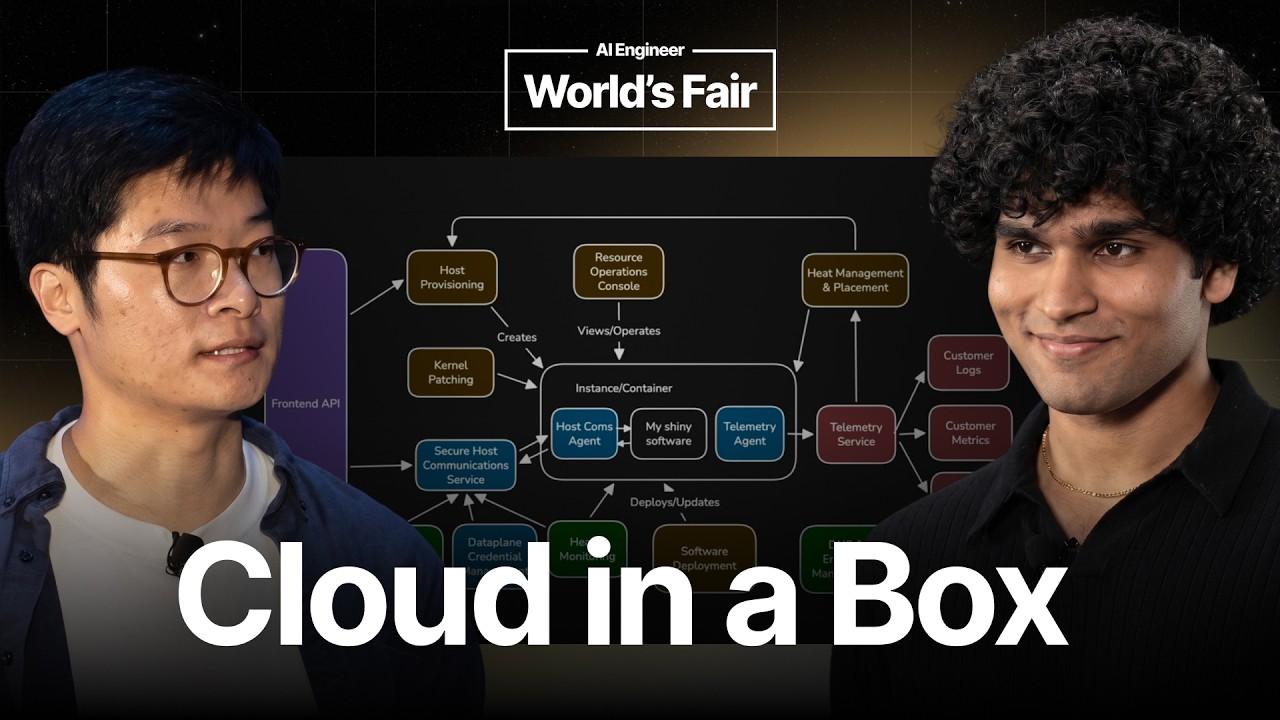
A single-node sandbox can simulate a distributed cluster with flapping nodes, lagging learners, live traffic, and repeated deployments, but Wang says this still fits the familiar pattern of a homogeneous post-training environment. Real companies do not run everything in one container. A cloud or infrastructure service needs host and resource provisioning, VPCs, subnets, security groups, customer-facing APIs, authentication, authorization, throttling, and sometimes audit systems such as CloudTrail. It also needs gradual deployment, rollback, version management, health monitoring, configuration changes, DNS, certificates, telemetry, billing, fraud controls, and administrative tools.
The proposed environment provisions real infrastructure
Once an environment reaches a certain size, Wang says a sandbox needs to provision real infrastructure rather than imitate everything inside one node. Emulated describes a multi-node sandbox with access to real cloud resources, which Wang jokingly calls putting a cloud in a box. Changing the sandbox in this way also changes the post-training pipeline. The environment itself can contain a post-training pipeline, allowing work involving model training and reinforcement learning infrastructure. The point is to give agents a setting where the systems they operate have the structure and dependencies of actual infrastructure.
High-fidelity environments still face time, cost, and sim-to-real limits
Wang says starting the full stack for a service such as AWS Lambda can take hours, which creates a problem for post-training rollouts. Real resources also create cost and resource-management constraints. Even with real infrastructure, a simulation still has a sim-to-real gap if it lacks live customer traffic and failures that only occur at a particular scale. Emulated is looking for people with distributed-systems experience or model-training experience because the company has not solved these problems. Wang specifically mentions hard operational details such as autoscaling and rolling deployments.
Emulated starts with infrastructure because domain knowledge improves the data
Wang explains that the company's name reflects its goal of emulating the real world with much higher fidelity. The longer-term aim extends beyond infrastructure to systems and entire companies. Infrastructure is the starting point because it matches the founders' background and because domain expertise informs data quality. Infrastructure companies also have clearer problem statements. A team building a service such as a GPU sandbox knows that users want low latency, low cost, and runs that do not fail halfway through. Wang says lessons from going deep in infrastructure may transfer to other domains, while the company also explores broader workflows.
"The real world is very, very complex, and how we as an industry emulate the real world is incredibly contrived and low fidelity."13:38
Who should watch
You are training coding or software-engineering agents and your tasks stop at a code diff, even though production work includes incidents, deployment, and infrastructure ownership.
You run distributed systems and want training environments that include node failures, live traffic, resource provisioning, and operational blast radius.
You are designing reinforcement-learning or post-training infrastructure and need to reason about environments that take real cloud resources, time, and cost to start.