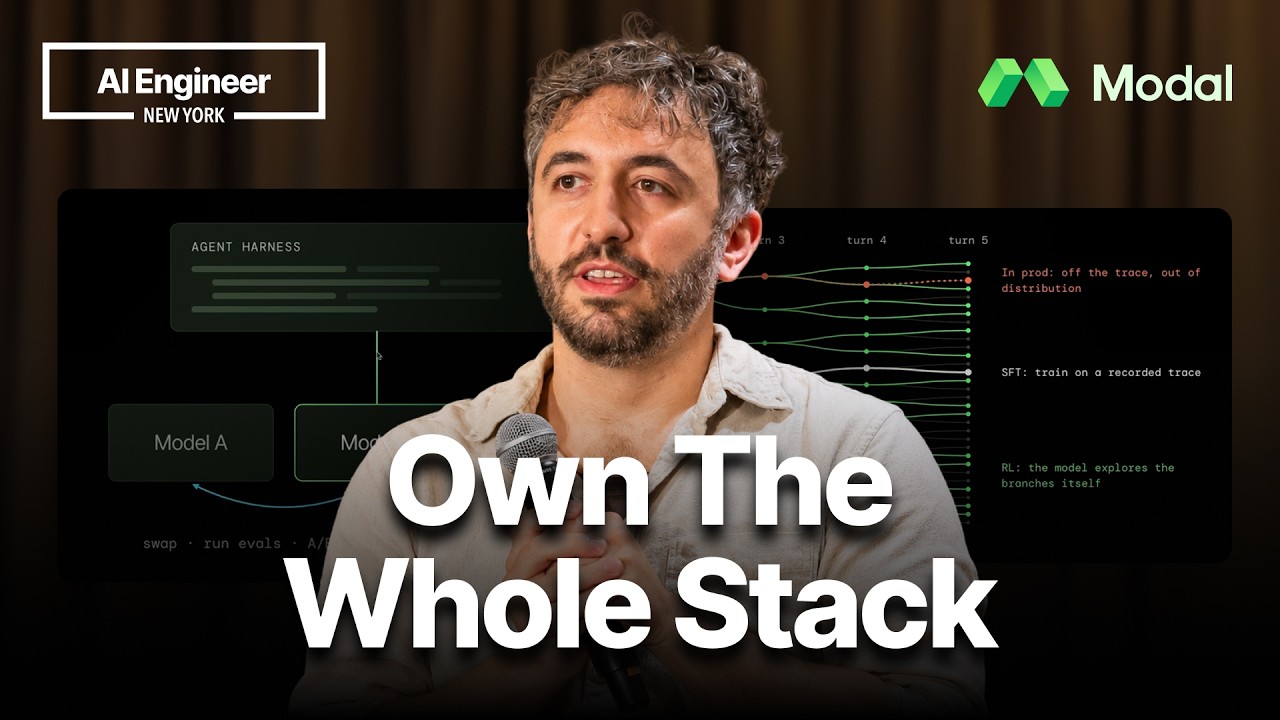
Production agent teams already have the harness, evaluations, and traces needed to build an RL environment.
2
RL explores alternate agent branches during training, while supervised fine-tuning on recorded traces can fail when deployment follows a different path.
3
Asynchronous RL can remain stable with GRPO, masked importance sampling, score centering, and top-p sampling, even when rollouts use different GPUs and quantization levels.
Summary
Jason Mancuso argues that models should become part of an agent team's product stack rather than remain interchangeable backends. Fine-tuning helps teams own inference, meet reliability targets, and handle proprietary data, but supervised fine-tuning on recorded traces is brittle because agents can take different branches at deployment time. RL explores those branches during training. Mancuso says production teams already have the foundations for this work: an agent harness, a way to evaluate changes, and live traces from which to create tasks. He explains an asynchronous RL setup where rollout workers and trainers run in parallel, then describes fixes for stale data and differences between samplers and trainers. The recipe uses GRPO, masked importance sampling, score centering, and top-p sampling with mask replay. Sparse weight updates let Modal distribute rollouts across providers, regions, GPU types, and quantization levels. Mancuso reports that this made rollouts 15% cheaper in one run.
Models should become part of the agent product rather than interchangeable backends
Mancuso says many AI engineers swap models, rerun evaluations, and rebuild their harness around whichever model offers the best price and quality. He argues this becomes a losing strategy when teams compete on both agent economics and user experience. Fine-tuning lets teams own inference and move together on latency, quality, and cost. It also helps with proprietary data that general models cannot handle. He expects more teams to integrate vertically across the stack as agents compete on task intelligence per dollar.
RL handles agent branches that supervised fine-tuning misses
Supervised fine-tuning trains on traces recorded during production. Mancuso says agents have a branching structure based on the number of turns and actions in a session, so a deployed model may encounter a different branch from the one in the training trace. He calls SFT brittle in this situation. RL can explore those possible branches during training. That is what people mean when they say RL generalizes better, according to Mancuso: the model trains against more of the session tree instead of copying a single path.
A production agent already contains the parts needed for an RL environment
Teams with agents in production usually have an agent harness and some way to evaluate or manage changes. Mancuso says those two pieces can form an RL environment. Production traces provide tasks, especially when teams mine failures and turn them into synthetic tasks. This gives training a direct connection to problems users actually encounter. He presents the process as more accessible than RL's reputation suggests, since the deployment, change-management process, and task source already exist inside many teams.
Asynchronous rollouts improve utilization but create stale-data problems
The RL loop runs model inference in an environment, collects rollouts, trains on them, and broadcasts updated weights back to the samplers. Sequential execution follows the clean mathematical order, but it leaves compute idle. Mancuso prefers running rollouts and training in parallel so GPUs stay busy. The cost is staleness: a rollout may come from model version V1 while the trainer is updating V3. Differences between trainer and sampler behavior can also arise from systems details, so the training method must correct for both stale data and implementation mismatch.
The stable recipe combines four techniques around GRPO
Mancuso's recipe starts with GRPO, then adds masked importance sampling, score centering, and top-p sampling with mask replay. Masked importance sampling corrects token-level mismatch from staleness and systems differences. Score centering removes drift that accumulates in the model weights over many updates. Top-p sampling prevents very rare tokens from entering rollouts, while mask replay handles the mismatch between the sampler's restricted distribution and the trainer. He says an ablation on Qwen 3.6 35B trained on code environments showed more stable training when the techniques were combined.
Modal separates training from rollout capacity with sparse weight updates
Modal's multi-provider fleet makes large contiguous training clusters difficult to schedule, while agent RL can devote roughly two inference GPUs to each training GPU. Mancuso says the actual weight updates are far sparser than the full model weights, by 100 or 1,000 times. Compressing those deltas reduces the data sent from the trainer to rollout engines by a factor of 1,000. Modal can therefore keep the training cluster in one location while placing inference GPUs across its wider fleet. He says this worked without introducing bad performance.
Different GPU types and quantization levels can share one RL run
Rollouts can run on different GPU types even though hardware kernels and numerical behavior add more mismatch between the sampler and trainer. Mancuso says the recipe handled a run with roughly four or five times as much mismatch as the homogeneous case while reward and gradient norm remained stable. The rollout fleet also used different quantizations, including BF16 and FP8 on H200 pools. He says the correction method can absorb mismatch from aggressive quantization and still learn from those rollouts.
Cheaper rollout hardware reduced the reported run cost
The mixed-GPU setup made the rollouts 15% cheaper in the run Mancuso described. High-end GPUs cost more because demand for them is higher, while less in-demand hardware can handle rollout work at a lower price. The figure used only basic off-the-shelf inference settings for each GPU type. Mancuso says further tuning, such as choosing different quantization levels for each deployment, could reduce the cost more, though that was outside this work's focus.
Mancuso concludes that teams competing with many other agent stacks need to own, or at least understand, every layer from the agent harness through training and inference. He says this vertical integration is already visible in coding and will spread to other industries. In his view, owning agent RL is now practical because the training methods have become more stable and the tools and infrastructure are available.
"The claim I want to make for this talk is that this is actually a losing strategy when you end up having to compete on not only the agent economics, but also the experience of the agent."00:41
Who should watch
You run an agent in production and already collect traces and evaluation results, but have not turned them into an RL training loop.
Your team is deciding between supervised fine-tuning and RL for an agent with many possible tool-use or conversation branches.
You need to spread rollout inference across mixed clouds, GPU types, or quantization levels without making training unstable.