Sovereign AI requires explicit control over data flow, model choice, infrastructure, observability, and operations.
2
Replacing hosted models and managed infrastructure can force new evaluations, multiple databases, hardware work, and incident processes.
3
A sovereign system should allow model swaps, retain reproducible run logs in a compliant location, and let the team handle incidents without calling a hyperscaler.
Summary
Bilge Yücel defines sovereign AI as an organization's ability to design, deploy, and operate AI systems on its own terms. He breaks this into data, model, infrastructure, and operational sovereignty. The talk focuses on the engineering consequences of retrofitting an existing system. Moving private data into the right jurisdiction can create multiple databases and make search harder. Replacing a frontier API with a self-hosted model requires API changes, prompt updates, and a fresh performance evaluation. Moving from managed infrastructure to on-premises exposes Kubernetes, networking, GPU, and vendor lock-in problems. Yücel presents Haystack as an orchestration layer that provides consistent interfaces, explicit data flow, YAML serialization, tracing, and model flexibility. His example architecture uses input and output guardrails, local tools, human approval, and observable agent execution. He closes with three tests for sovereignty: model swappability, compliant reproducible logs, and independent incident response.
Sovereignty means technical control over the whole AI system
Yücel defines sovereign AI as the ability to design, deploy, and operate an AI system on an organization's own terms. For engineers, that means explicit control over data flow, model choice, infrastructure, observability, and operations. He divides the subject into four pillars. Data sovereignty covers where data is stored and processed. Model sovereignty covers who controls the model and where its training data came from. Infrastructure sovereignty covers where computation happens. Operational sovereignty covers traceability, updates, monitoring, and incident response.
Data sovereignty depends on processing location and access permissions
Data must be stored and processed in trusted jurisdictions to meet compliance requirements. Yücel uses a concrete example: sending European citizen data to an embedding API hosted in Virginia means the organization has lost control of that data. Permissions also matter. Employees who can access data they are not meant to see create a sovereignty problem even when the storage location is compliant. The issue is therefore about the full data path and the people who can reach it.
Infrastructure choices trade control against convenience
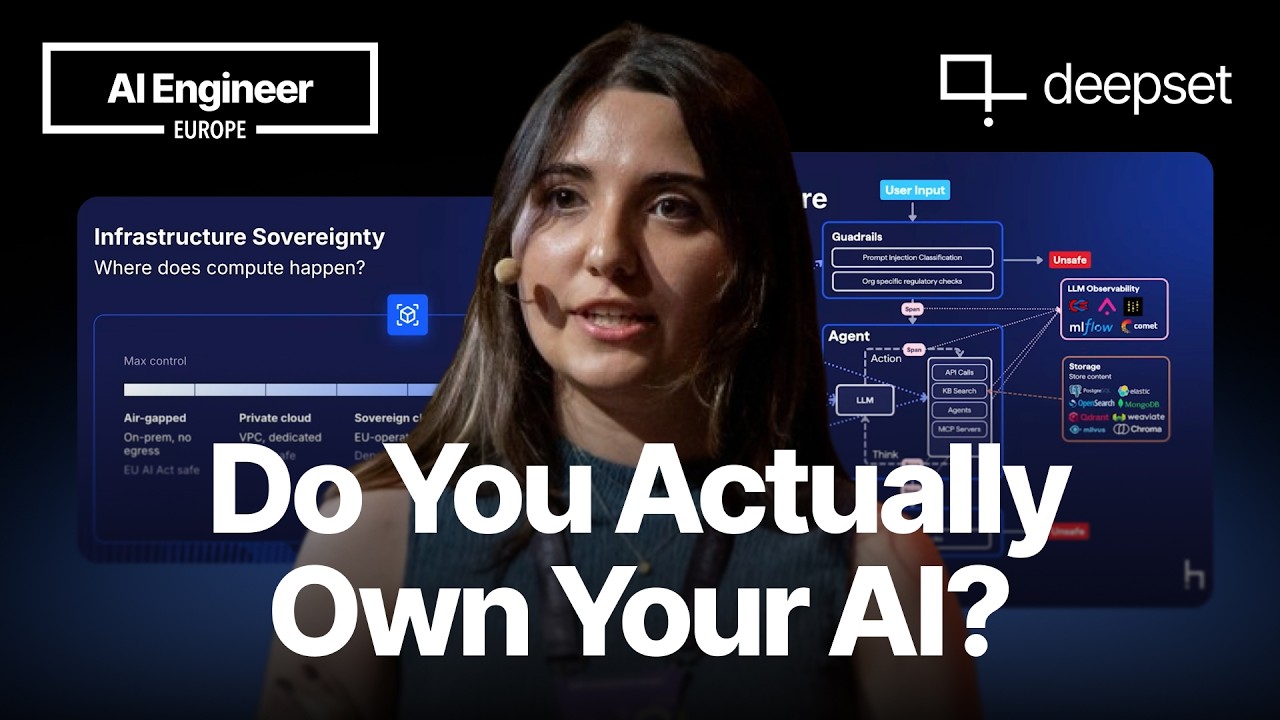
Yücel describes infrastructure sovereignty as a spectrum. An air-gapped environment gives the organization maximum control. A private VPC offers a different level of control, while sovereign cloud depends on the provider. SaaS is more convenient, but a US-headquartered provider may retain the ability to access running data under the Cloud Act even when the application runs in Europe. Organizations need to choose the level of control that fits their domain instead of assuming every system needs the same setup.
Model dependence creates outages, cost exposure, and expensive rewrites
Model sovereignty requires freedom to choose and switch models. If an application works with only one provider's model, an API outage removes access and a price increase creates a cost problem. Even when several models are technically supported, the application may still be tightly coupled if changing models requires broad code changes. Yücel also raises training data origin as part of model sovereignty, while acknowledging that buyers often cannot determine exactly what data a model was trained on.
Retrofitting sovereignty forces a fresh performance evaluation
The first common retrofit is replacing a frontier API with a self-hosted model. That change requires translating the existing API logic to the new model architecture and may require prompt updates. Yücel says teams then need to evaluate the system's performance from scratch and write substantial new code. Moving private data into the required jurisdiction creates another burden: teams may end up managing multiple databases and instances, then must decide whether to classify queries or send them to more than one database.
Replacing managed infrastructure with on-premises deployment reveals how much work cloud providers had been handling. Teams must deal with Kubernetes cluster management, model serving, and connections between application and model infrastructure. Hardware limits also appear. The application layer may run on CPUs while the model runs on GPUs, which creates connection and network management work. These tasks expose vendor lock-in that was easy to miss while infrastructure remained managed.
Traceability needs to cover agents, versions, and compliance records
Adding observability to an existing AI system can reveal a black box. Teams need to understand what happens in the application layer and log it so the system is auditable. They also need version control for the application and its model-related configuration. Yücel places monitoring, evaluation, controlled updates, and human review within operational sovereignty. In high-stakes areas such as HR and finance, human involvement is required for production behavior and decisions.
Haystack reduces coupling through declared pipelines and swappable components
Yücel presents Haystack as a way to address some of these engineering problems. Its consistent interfaces can allow a system to move from a cloud model to a self-hosted model with a small code change, although the framework cannot solve GPU limits. Inputs and outputs are typed and declared, which makes data flow visible even in agent systems. Applications can be serialized to YAML and stored in version control. Open source code also lets teams inspect and extend components instead of relying on a black box.
A sovereign agent needs guardrails, human approval, and local tools
The example architecture places an input guardrail before the agent to check for prompt injection and regulatory conditions. Safe requests reach an agent with a system prompt and tools, while unsafe requests leave the application layer. An output guardrail checks compliance before information reaches the user. Tools can include APIs, knowledge-base search, other agents, and locally hosted MCP servers. The design can require human confirmation for requests or for specific actions such as listing payment requests. Tracing covers the pipeline and agent execution.
"If you send that data to an embedding model, to an embedding API hosted in Virginia in the US, then you are already losing the control of your data."02:48
Who should watch
Your team runs AI through hosted APIs and needs to understand what changes when data, models, or compute must stay within a specific jurisdiction.
You are moving an agent or RAG system on-premises and want to identify infrastructure work and vendor dependencies before the migration.
You build AI for finance, healthcare, HR, or another high-stakes domain where audit logs, human approval, and independent incident response matter.