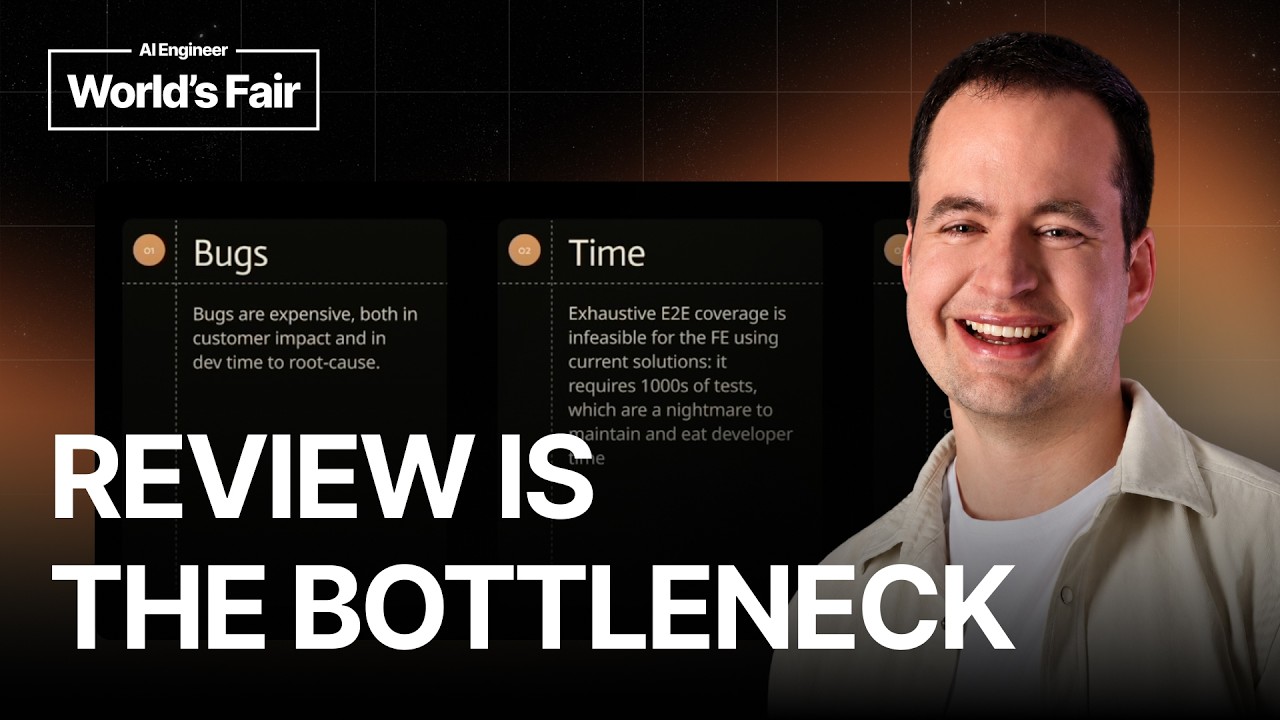
AI-generated code shifts the bottleneck from writing software to reviewing and verifying it.
2
Assertion-based tests cannot cover the possible regressions created by different flags, permissions, settings, configurations, and edge cases.
3
Meticulous records frontend workflows, replays selected flows on pull requests, and uses screenshots and visual diffs to show what changed.
Summary
Gabriel Spencer-Harper argues that faster code generation does not increase shipping speed when verification still depends on human review and hand-written assertions. The possible regression space includes feature flags, roles, permissions, settings, configurations, and application branches. Meticulous records real frontend workflows in nonproduction environments, replays a coverage-selected subset on each pull request, and compares screenshots taken after every interaction. Developers review before-and-after diffs rather than trying to define every expected result in advance. The system uses mocked network traffic to isolate tests, a deterministic browser to reduce flakes, and a code-coverage index to select flows. Spencer-Harper says this makes code coverage more meaningful because every covered step also produces a visual check. The approach is intended to make broad dependency updates, refactors, and AI-generated changes easier to review, while leaving judgment about whether a visual difference is expected with the developer or an agent.
AI moves the bottleneck from coding to verification
Spencer-Harper says agents can write code faster than humans can review it. Without exhaustive verification, someone in the organization must spend time checking the change, so teams trade development speed against bugs and user experience. He frames the problem around a pull request generated by AI: most engineers would not merge it without checking feature flags, roles, permissions, settings, configurations, and edge cases.
Assertion tests cannot describe every possible regression
The speaker says assertion-based testing is limited because humans or agents must define correct behavior in advance. The space of possible regressions is too large to cover exhaustively with assertions. He connects this gap to bugs and regressions, time spent maintaining end-to-end suites, manual validation, review, flaky-test debugging, and test updates.
Visual replay shows the effect of a change without predicting every bug
Meticulous adds one line of JavaScript to nonproduction environments and records workflows such as opening login, settings, and analytics. On a pull request, it starts the application locally, replays selected workflows, and captures a screenshot after each atomic event. It compares the old and new screenshot sequences and posts a pull request comment with before-and-after diffs. The developer decides whether each difference is expected.
Mocked network traffic isolates and repeats workflows
At record time, Meticulous captures network requests and responses. During replay, it stubs those responses back in. Spencer-Harper gives two reasons: the same test can run repeatedly with the same results, and each test is isolated from the others. Isolation removes race-condition risks and allows tests to run in parallel.
Spencer-Harper says ordinary browsers contain sources of randomness because determinism was not part of their original design goal. He mentions animation timing, CPU clock speed, and the interval between timers as examples. Meticulous changes the browser from the scheduling layer upward so these sources of randomness are controlled and workflows produce fewer flakes.
Coverage-guided selection makes a large workflow set practical
The system replays every recorded session against the main branch and tracks the lines of code executed by each workflow. It builds a map from workflows to code lines, then selects a subset that maximizes application coverage. Spencer-Harper presents this as the way to cover feature and plan combinations, permissions, roles, configurations, and different branches without replaying every workflow on every pull request.
Screenshots make code coverage closer to tested behavior
Spencer-Harper criticizes ordinary coverage metrics because a Cypress or Playwright test could cover the whole codebase while making only one assertion. Meticulous captures a screenshot at every moment in a flow, so a visual difference at any step can be flagged. He says this makes covered code approximately the same as tested code, although the volume of screenshots also requires the system to control noise and flakiness.