AI writing feels like slop when it uses overused words, vague claims, repetition, hallucinations, and a voice that does not sound like the intended writer.
2
Tone-Bench tests creative writing with 10 scripts, five drafts per model, four LLM judges, nine metrics, and 1,000 human A/B comparisons.
3
Better results come from long prompts packed with examples, one review pass from a strong model, several cheap drafts merged together, and a final human edit.
Summary
Louis-François Bouchard defines slop as writing that feels generated because it relies on familiar words, general statements, repetition, unsupported claims, and an unclear voice. He introduces Tone-Bench, a benchmark built to test whether a model can write a video script in his style. Each model produces five drafts for each of 10 scripts. Four LLM judges score nine metrics covering tone, writing quality, instruction following, research accuracy, and slop. The team also ran 1,000 human A/B comparisons. Bouchard explains that judges often favor their own model family, so evaluations need judges from different families. Building the benchmark took about 500 hours and thousands of dollars, with prompt changes costing thousands more. His practical advice is to use very long prompts with positive and negative examples, ask a strong model for a limited review pass, generate many drafts with a cheaper model, merge the best parts, and keep a human in the editing process.
Slop combines familiar wording with content that says little
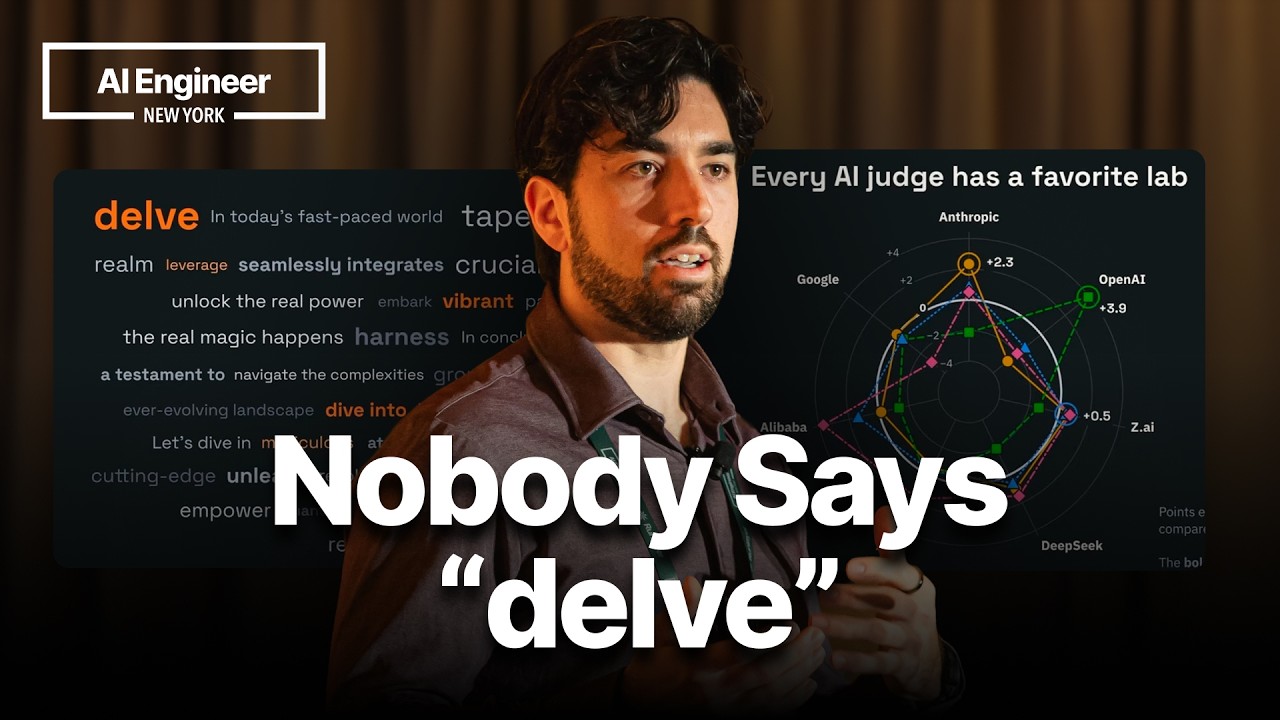
Bouchard describes slop as writing that feels generated rather than written by a particular person. It often contains overused language such as "delve," broad statements about themes or projects, and polished phrases that communicate little. Sloppy writing repeats itself, hallucinates facts, and cannot be trusted without checking. Its voice is also wrong: it may have no distinct tone, or it may sound like everyone at once. For Bouchard, the problem is larger than spotting a list of banned words. A text can avoid those words and still be vague, repetitive, inaccurate, or unlike the person who is supposed to have written it.
A creative-writing benchmark should measure voice as well as correctness
Bouchard introduces Tone-Bench to measure whether models can produce creative writing in a specific voice. His test asks whether he could read a generated script aloud without cringing at wording he would not use. The benchmark gives each model a brief, research material, detailed instructions about his writing and speaking style, and many examples from his previous videos. The goal is a complete video script that he could have written. He built it because Towards AI produces educational videos, articles, and books with a small team, and reviewing generated drafts had become a repeated source of work.
Five drafts reveal how unstable a model is on creative tasks
Tone-Bench uses 10 scripts, some published and some withheld to check for contamination. Each model generates five drafts for every script, rather than producing only one answer. Bouchard uses the set to measure intra-model variability. In his example, one Grok 4.7 draft was as good as an Opus 5.5 result, while the other drafts did not reach that level. He says weaker models tend to have wider variation. Five drafts were a practical middle ground for the team's cost, while still showing whether a model can produce a good result consistently rather than by chance.
The rubric scores voice, writing, instructions, research use, and slop
The benchmark has nine metrics, grouped by Bouchard into five areas. Tone asks whether the text sounds like him. Writing quality covers elements such as hooks and emotional transitions. Instruction following checks the requested length, format, images, and placement. Research accuracy checks whether the model used the research brief correctly or hallucinated. The final area measures slop with EQ-Bench's slop score and the team's own measures. Judges receive about 1,000 words of guidance and examples for each metric, the reference script, and the research brief. The full judge prompt is about 14,000 tokens.
Structured judge categories work better than a direct percentage
For the tone and voice metric, the judge first places a draft into one of six categories, then assigns a rating within that category. Bouchard says this worked better for the qualitative task than asking for a binary answer, a category alone, or a direct percentage. The judge returns scores for all nine metrics, a justification, and a specific example from the writing that supports the score. The system does not ask the judge to assess every property in the same way. Length and some other facts are checked afterward with code, while the judge concentrates on writing quality.
The evaluation is automated because 120 models, five drafts, and 10 tasks quickly produce thousands of scripts. Bouchard found that judges have strong preferences, especially for their own family of models. He describes a particularly strong OpenAI preference across OpenAI models, rather than a bias toward only one model. He also says Anthropic and OpenAI appeared to rate each other poorly. His recommendation is to use judges from different model families when comparing models. A single judge can make a leaderboard reflect the judge's preferences instead of the writing quality being tested.
Human comparisons provide a check on automated creative-writing scores
The team compared generated writing by hand because human evaluation is useful for a subjective creative task, even though it is difficult to scale. Bouchard and three teammates reviewed 1,000 A/B pairs. They compared a substantial, comparable section of two generated scripts rather than always reading entire scripts. He hopes to publish more of this work and involve the community later. The human checks do not remove the subjectivity of the benchmark, since Tone-Bench measures whether writing matches his own voice, but they give the automated judges a separate point of comparison.
Writing with AI works better when the model gets examples and limited review
Bouchard says the benchmark changed how he thinks about choosing models for creative work. He would rather use a model that is less annoying to bring toward the desired result than one that occasionally produces a perfect first draft. His practical method starts with a very long prompt containing examples of what to do, examples of what to avoid, unwanted words, and full samples of his own work. He recommends one to three review passes from a strong thinking model, because repeated review can turn into more slop. For API workflows, he suggests generating around 10 drafts with a cheaper model, asking a stronger model to select and merge the best parts, then having a human edit the result.