Pack · 11 talks · 3h 14m to watch, 60 min to read

AI in finance: numbers that survive review

In finance a fluent answer is worth nothing until someone can trace every number in it. The pack starts with that standard: an investment memo must survive a room of people looking for errors, and off-the-shelf models bluff about money because they have read advice rather than watched outcomes. The next talks keep figures out of the model's hands, audit the assumptions behind a forecast and record enough of each run to defend it to an auditor. Then come three ways to test an agent: synthetic businesses, earnings with a known answer, and a live distressed credit with none. The pack ends with the fund: how to split the work, how to measure what AI earns, and where people still decide.

1
Shawn Chan, China Resources Holdings · 24:23 · AI Engineer World's Fair 2026
Build for the Memo, Not the Demo

Why first: Chan sets the standard the rest of the pack is measured against. A demo has to impress a room for a few minutes; an investment memo has to survive a room of people looking for errors before money moves. His requirements are concrete: each claim linked to its source paragraph, figures that agree across documents, contradictions shown rather than smoothed away, estimates labelled as estimates, and a named human who signs.

2
Udi Menkes, Intuit · 19:50 · AI Engineer World's Fair 2026
Why Off-the-Shelf AI Doesn't Understand Money

Why second: Chan says every claim must survive the room. Menkes shows why a frontier model's advice about money often cannot. It learned from blogs, books and advice columns, not from watching similar businesses act and seeing what happened, so its recommendation flipped when he changed one assumption. Intuit lets the frontier model propose actions and a model trained on observed outcomes choose between them.

3
Vinoo Ganesh, Kepler · 20:58 · AI Engineer NYC 2026
Do Not Let Models Invent Numbers

Why here: Menkes separates proposing from choosing. Ganesh makes the same kind of split for figures: the model plans and cites, retrieval finds the source, code does the arithmetic, and a filter strips any number it cannot match. Each fact keeps its unit, scale and period. In Kepler's evaluations of plain RAG, the filter refused 10,981 citations and about 3,810 were simply wrong numbers.

4
Hassan El Mghari & Omar El Mghari, Together AI · 15:25 · AI Engineer NYC 2026
Right Answer, Wrong Reasons: AI Forecasts Costco

Why here: Ganesh stops the model inventing numbers. Hassan and Omar El Mghari show that sourced facts and structured formulas are still not enough. Their Costco forecast landed within 4.4 percent of the actual result only because two wrong assumptions cancelled out: the fee increase applied to every member instead of the US and Canada, and a 15 percent executive share where the filings said 45. Fixing one error took the miss to 28 percent.

5
Anirudh Veeraragavan, Fieldguide · 13:28 · AI Engineer NYC 2026
Your Financial Agent Needs to Show Its Work

Why here: the Costco audit checks one forecast. Veeraragavan asks what an auditor needs from every run: an agent that cannot overwrite work a human already signed off, recorded steps that can be rerun one at a time, citations tied to an exact document version and content hash, and gold data that is itself checked. A 97 percent score, he shows, can hide bad labels and changed audit rules.

6
Ryan Stevens, Ramp · 18:39 · AI Engineer NYC 2026
How Ramp Tests Its AI Bookkeeping Agent Before Customers Do

Why here: Veeraragavan warns that reviewed examples make unreliable gold data. Stevens shows how Ramp built test data it could trust before it had customers: synthetic businesses with their own ERP, vendor lists and accounts payable. He leans on pass@k over partial credit because one wrong step can make a reconciliation unusable to an accountant, and Ramp found its agent failed by reasoning badly, not by missing data.

7
Ashwin Paranjape, Samaya AI · 15:21 · AI Engineer NYC 2026
Can AI Agents Beat Wall Street at Predicting Earnings?

Why here: Ramp tests in a stable invented world. Paranjape tests against the real one. Earnings come with a reported number and an analyst consensus to beat, and a point-in-time gate stops the agent seeing anything published after its prediction date. Across more than 450 reports the newest models began to beat consensus, and data 11 weeks old cost 12 to 15 points against current data.

8
Harneet Kaur, Axim Intelligence · 14:15 · AI Engineer NYC 2026
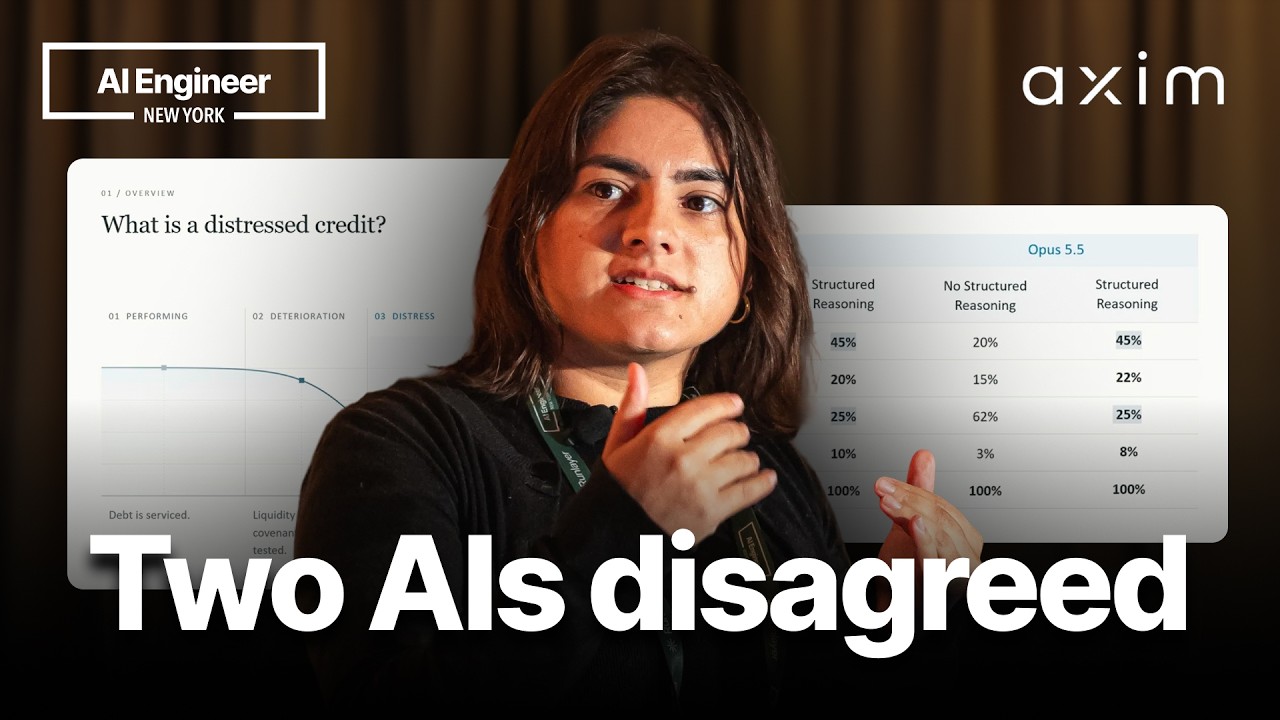
Can AI Understand a Distressed Credit?

Why here: Paranjape chose earnings because the answer arrives every quarter. Kaur chose iHeartMedia because nobody knows the answer yet. Given the same context, Opus 5.5 put bankruptcy at 62 percent and GPT-6 Astra at 25. Once she split the work into extraction, derivation, judgment and prediction, both landed near 25 percent, and she says plainly that agreement does not prove either is right.

9
Frank Long, Coatue · 14:05 · AI Engineer NYC 2026
AI Agents Will Upend Investing Even More Than Coding

Why here: Kaur breaks one credit analysis into layers. Long breaks a whole fund down the same way: a function that turns external and internal context into what to buy, how much and when. Each step gets the runner that does it best, whether code, statistics, an LLM or a person. Without a quality target to tune against, he says, changing any of them is fidgeting.

10
Hari Kumar, Contour Asset Management · 18:24 · AI Engineer NYC 2026
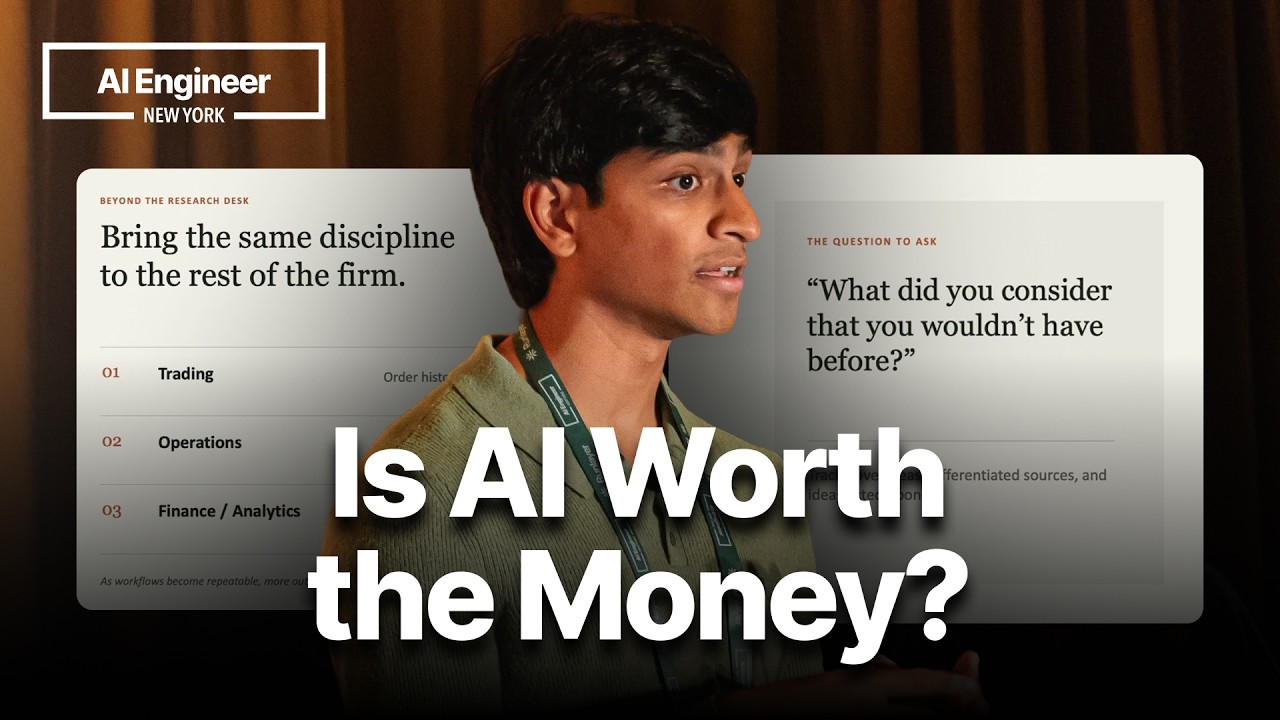
Proving Alpha: How a Hedge Fund Measures AI's ROI

Why here: Long says you need a quality target. Kumar shows what a fund can measure when a trade may take a year to pay off. Contour compares an analyst's research on a company with and without AI from one earnings report to the next, tracks a cost per useful insight, and counts the staff time spent repairing model calls and connectors that break every few days.

11
Jack Woodruff, Candlestick Capital & Vinoo Ganesh, Kepler · 18:46 · AI Engineer NYC 2026
Why AI Won't Replace Stock Pickers

Why last: Kumar measures what AI saves. Woodruff says where the saved time should go: proprietary research, channel checks and industry work, because once every fund has the same models, the edge comes from choosing what to investigate. He would never sign off on a model's number without seeing its source, and expects a no-analyst fund to reproduce last year's fund and fall behind.