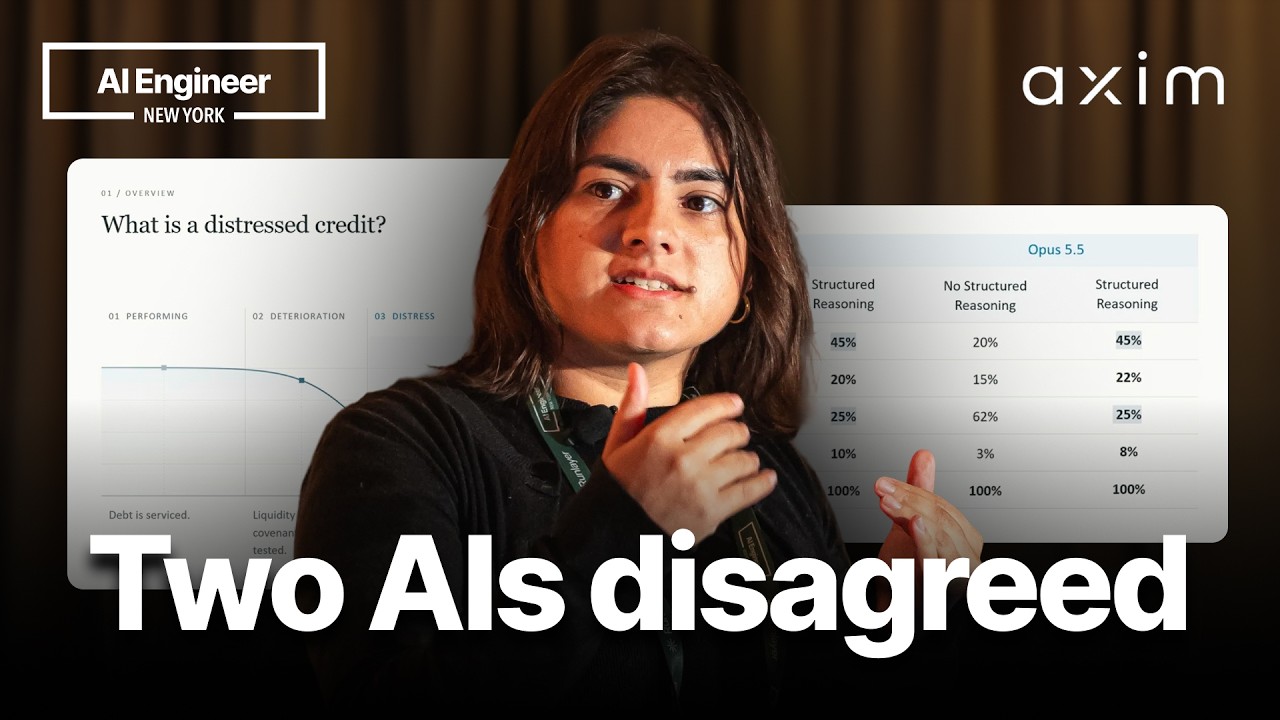
Distressed credit can end in bankruptcy, a liability management exercise, an out-of-court restructuring, or refinancing, so predicting bankruptcy alone is too narrow.
2
Two frontier models gave sharply different probability estimates for iHeartMedia's future when given the same context.
3
Checking extraction, derivation, judgment, and prediction separately made the models converge on negotiated restructuring as the more likely outcome, without proving that outcome is correct.
Summary
Harneet Kaur explains why distressed credit is difficult for both traditional scoring systems and AI. A company can face liquidity, legal, capital-structure, and operational questions, while the eventual outcome may be bankruptcy, a negotiated restructuring, or another transaction. Kaur tests two frontier models on iHeartMedia, a live situation with no known future outcome. The models initially disagree about the probability of bankruptcy and restructuring. She then breaks the analysis into extraction, derivation, judgment, and prediction layers. This makes it possible to check whether the models have the right data, calculations, and interpretation before asking them to predict what happens next. With the structured process, the models converge on a similar view, including a 25% bankruptcy probability and a preference for negotiated restructuring. Kaur is careful about the limitation: convergence does not establish correctness when there is no ground truth. It may show consistent reasoning, or it may simply produce the same wrong answer.
Credit is a corporate bond or loan. It becomes stressed or distressed when an underlying risk could cause a company to run out of money or fail to repay its debt. Kaur gives cyclical problems, operational failures, and secular disruption as possible causes. Bankruptcy is only one outcome. A company may instead go through a liability management exercise, an out-of-court restructuring, a negotiated exchange, or refinancing. That makes the question more complicated than predicting whether a default will happen.
Traditional credit scores do not track changing situations well
Kaur says the old engineering problem was often binary: predict whether a company would default. Distressed situations now change monthly, quarterly, or yearly, while private credit has made parts of the market more opaque and less frequently priced. She uses the Altman Z-score as an example of a static measure that does not capture those changes. Human investors can examine financial statements, lender positions, and credit documents, but that work is manual and difficult to scale.
Understanding a credit requires financial, legal, and business analysis
An investor needs to answer questions about liquidity and the capital structure, then determine the legal priority of each debt claim. The analysis also covers the business itself, including its revenue and whether revenue may rise or fall. Kaur contrasts this broad process with benchmarks that test individual finance questions, such as whether a model can identify structurally senior debt. Her deeper test is whether a system can use those answers to predict what happens next.
A live distressed situation has no verified answer yet
Kaur chooses iHeartMedia for the test. The company filed for bankruptcy in 2018 and completed another stressed transaction in 2024, but its current future remains uncertain. She gives the same context to GPT-6 Astra with maximum reasoning and Opus 5.5. The models disagree about the probabilities of future outcomes, including bankruptcy and negotiated restructuring. Since no one knows what will happen, there is no ground truth that can immediately tell her which probability is right.
The analysis can be checked as four separate layers
Kaur separates the work into extraction, derivation, judgment, and prediction. Extraction means obtaining facts such as EBITDA from documents. Derivation combines facts, such as EBITDA and debt, to calculate leverage. Judgment interprets that leverage and asks whether the company is distressed. Prediction comes last, after checking the underlying data, calculations, and interpretation. She says extraction is mostly solved for public companies, while private loans and Excel or PDF documents remain harder.
Structured reasoning made the models agree on the same path
After introducing the layered process, the two models converged on a similar probability distribution. The earlier result had Opus at 62% bankruptcy and Astra at 25% bankruptcy. After the structured analysis, both models put bankruptcy at about 25% and agreed that negotiated restructuring was the more likely path. The process changed the models' assessment from a sharp disagreement to a shared view.
Agreement does not show that the prediction is right
Kaur says the models have no demonstrated predictive edge on questions that cannot yet be verified. A structured process can make different systems converge on the same view of a business and its possible future, but the correct path remains unknown. Historical analysis can also create look-ahead bias. She finds convergence interesting because a repeatable process that produces the same probabilistic outcome resembles what a market price expresses, but she does not treat that resemblance as proof of accuracy.
"The true understanding, right, of credit, and particularly distressed credit, is can you predict what happens next?"05:47
Who should watch
You are building AI systems for financial analysis and need to separate document extraction from calculations and analyst judgment.
You work with distressed debt, private credit, or restructuring cases where the outcome has several possible paths instead of a simple default prediction.
You want to evaluate model agreement without treating agreement as evidence that a forecast is correct.