A software factory is existing engineering practice with an agent taking on the building work.
2
Agents can produce more code than people can review, so teams need planning, testing, linting, monitoring, and human judgment around the agent.
3
Slop is output whose quality and usefulness do not justify the effort required to understand it, and it compounds when teams keep passing it along.
Summary
Dex Horthy argues that software factories are not a new category of engineering. They are familiar practices such as planning, pull requests, CI, static checks, feature flags, monitoring, and review, with agents added to the build step. The hard part is controlling quality over time. Horthy points to Slop Code Bench, where the best reported model score is about 16% on evolving an existing codebase, as evidence that agents can solve isolated tasks without maintaining a system well. He recommends forward pressure to start work automatically and back pressure through testing, review, and verification. His twelve practices include planning around expected rework, visual alignment, agent-run tests, anti-slop lint rules, feature flags, evaluations, and a unified forge for code and decisions. The Anti-Slop Manifesto asks people to own the intent and consequences of AI-assisted work. Horthy still expects humans to review some outputs, with the amount depending on the stakes.
A software factory adds agents to familiar engineering loops
Horthy describes a pre-AI software factory with engineers and product managers putting work in a tracker, building it, running tests, opening pull requests, and using CI, linters, canaries, rollouts, and feature flags before release. Monitoring sends incidents back to the team. His agentic version changes the build step: instead of a person building the thing, an agent builds it. The surrounding engineering process remains familiar. He says the factory mindset is about standardizing the process as well as the output.
Forward pressure starts work and back pressure improves its result
Forward pressure answers what causes new work to start. Feature requests could go directly into the factory, and an incident at 3:00 in the morning could produce a pull request aimed at fixing it instead of only showing a stack trace. Back pressure handles the slower part that remains after agents build quickly. Agentic review, agentic testing, CI/CD, linters, and even formal checks can help agents improve an outcome before a human sees it. Horthy frames the goal as letting agents climb toward a better result without requiring human involvement at every step.
Current models struggle to maintain a codebase as it changes
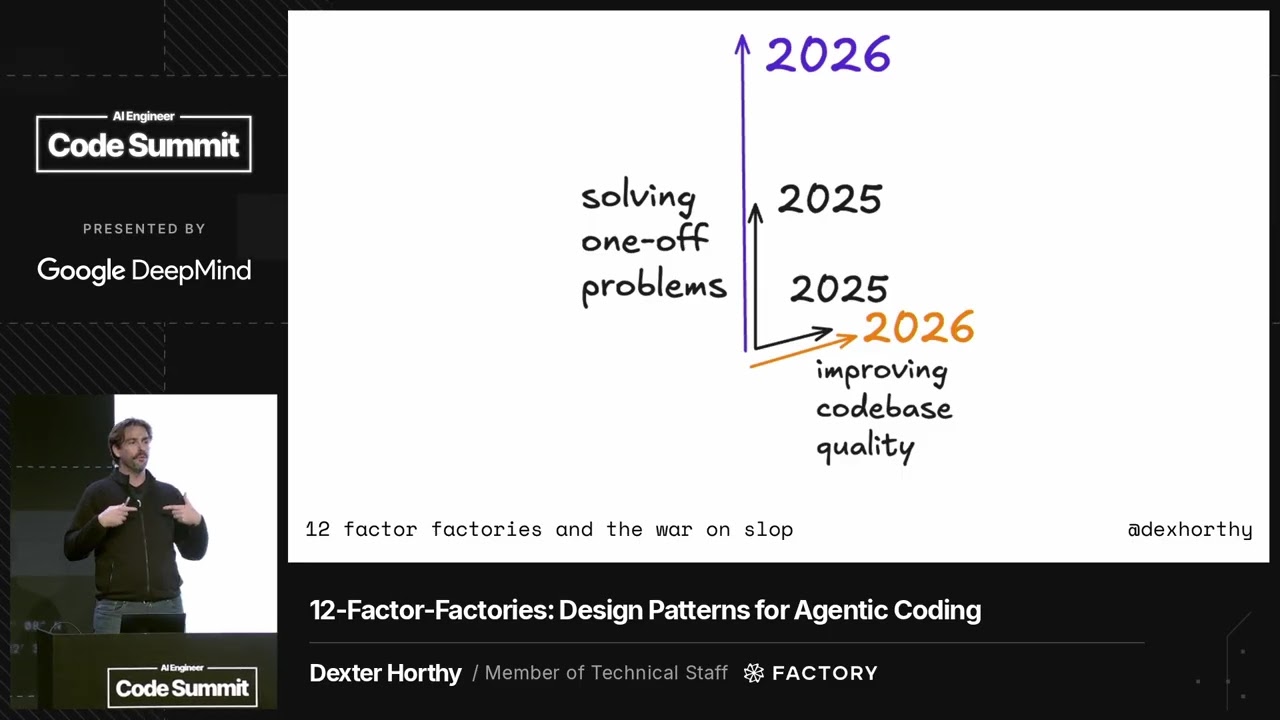
Horthy says unattended models can solve one-off problems while failing to improve code quality over time. Slop Code Bench tests this by asking a model to evolve a codebase through successive checkpoints, rather than recreating a whole system with all requirements known in advance. The reported best score is around 16%. The benchmark checks complexity, functions with high complexity, library and interface design, and more than 200 custom rules. Horthy says newer models can reproduce poor patterns, including Python 2-style code in Python 3, so teams need to understand the system and its code.
Planning should reflect the cost of changing a decision later
Horthy recommends planning before building, while admitting that detailed planning can be excessive for small tasks. He describes planning as a question of expected pain: how likely a decision is to change, multiplied by how difficult it will be to change. He does not want to spend time debating a button color during planning, but he does want database schemas and other hard-to-change decisions to be right before the agent spends time and tokens. Teams should choose where to sit between a short prompt and a detailed specification based on the problem and the codebase.
Visual artifacts and executable tests give agents better feedback
Horthy describes his Show Me skill, which asks agents to produce HTML mockups, tables, and charts instead of only walls of text. He says visual material is easier for people to inspect. He also wants agents to test their own work with screenshots, browsers, videos, curl, or whatever the environment supports. An iOS agent should be able to build, run, and test the app in its environment. These checks give the agent feedback about the outcome instead of relying only on a textual description.
Lint rules can block recurring forms of agent-generated slop
Horthy points to Anti Slop, a repository with roughly 100 rules aimed at stopping agents from building poor code, and mentions Factory's ESLint plugin. He also recommends using the Python code-quality rules from Slop Code Bench. He does not say every line must be perfect. Prototypes, side projects, and work behind a feature flag can justify rougher code when the team is testing whether an idea is wanted. The standard should depend on whether the code undermines the outcome.
Feature flags, evaluations, and a unified forge make work easier to control
Horthy recommends giving models a feature-flagging system such as PostHog, Statsig, or LaunchDarkly so they can try changes and compare performance before committing to a direction. He also asks teams to evaluate everything and learn from earlier sessions. A unified forge should bring code, designs, decisions, and other project knowledge closer together. He contrasts this with people copying Claude answers through Slack, which loses the context behind decisions and makes it harder to understand why a system was built the way it was.
Some parts of a factory depend on the team's own standards
Horthy says teams can buy infrastructure such as virtual machines, a development environment, an agent harness, and a control plane for collaboration, scheduling, events, and governance. They cannot buy a universal answer for whether their code is correct. A team with many engineers and repositories has its own opinions about how the system should be tested. For Horthy, the software factory is partly a way of thinking about work, with purchased building blocks around it rather than a complete product that can decide what quality means.
Human review remains necessary when the stakes justify it
The Anti-Slop Manifesto says people should value outcomes over outputs, understanding over speed, and their own thinking over a model's first draft. Horthy defines slop as work that asks the reader to spend more effort understanding it than the producer spent making it. AI output becomes slop when people pass it on without taking responsibility for its quality or the reader's experience. Agent reviewers, linters, and verifiers help, but they are not sufficient. Humans should review some subset of outputs, with the amount depending on what ships, who uses it, and the stakes.