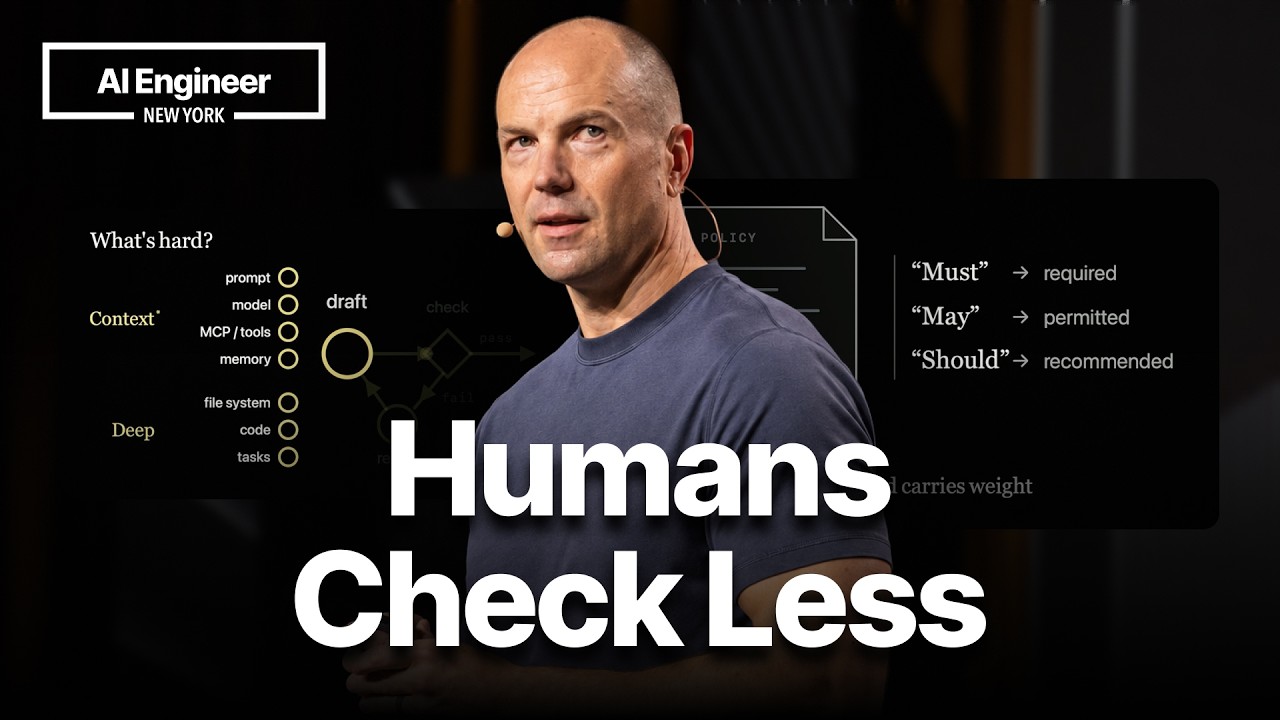
Policy defines the boundaries for agent-driven work, while the workflow outside the agent should remain deterministic.
2
An agent loop is only trustworthy when its check has a clear definition of good work and a reliable evaluation method.
3
Teams can move from full supervision to sampling and then exception handling as measured confidence reaches policy thresholds.
Summary
Evan Kormos presents a way to introduce agents into regulated, policy-driven workflows. He starts with policy as the organization's original system prompt, then separates that policy from the system's changing run state. Workflows can be modeled as directed acyclic graphs, with parallel steps and required gates. Inside each node, agents and people work through loops that use feedback until an output passes a check. The check is the difficult part because the agent is probabilistic and repeated attempts do not guarantee better work. Kormos recommends representative datasets, repeated evaluations, statistical analysis, and traces of runtime behavior. Teams should choose agent-owned steps by asking whether the work can be checked against policy, run in a bounded loop, traced, and handed back to a person. Deployment progresses from full human supervision, to sampled review, to humans handling exceptions after confidence crosses a policy threshold.
Policy provides the outer boundary for changing systems
Kormos calls policy the organization's "original institutional intent" and "original system prompt." It uses words such as "must," "may," and "should" to define rules and decisions, especially around risk and compliance. He separates the build state, where policy and systems are defined or changed, from the run state, which is constantly moving as products change. The running system should remain roughly bound by the policy even as its implementation evolves. This distinction gives agents a boundary for their work without assuming that the workflow itself stays fixed.
Kormos places agents across the familiar enterprise model of people, process, and technology. They work with people, execute parts of a process, and use or consist of technology. The talk focuses on the point where agents meet process: deciding which work to give them, setting boundaries, and building trust in their outputs. This framing avoids treating an agent as an isolated software component. It makes the workflow and its relationship with people part of the design.
DAGs expose dependencies and create room for parallel work
A workflow can be represented as a directed acyclic graph, or DAG, whose nodes and dependencies describe a flow that moves forward without looping back. Kormos uses examples such as approval before a change goes live and verification before opening a customer account. Agents make it worth revisiting which steps can run in parallel. Independent reviews can happen alongside one another while required checks remain in place. He names Apache Airflow as an open-source example that represents workflow dependencies as DAGs in Python code, including policy-driven processes such as commercial lending and token listings.
Inside a process node, work moves through a loop. In Kormos's code review example, the system performs several steps, checks whether the work is good enough, and passes it onward when it meets the bar. If the review finds problems, feedback sends the work back for another iteration. He describes this inner structure as a directed cyclic graph, or DCG, and mentions LangChain LangGraph for managing its state. The outer workflow still has a policy boundary, while the inner node can adapt through repeated work and feedback.
Adding agents changes the volume across a process. If code reviews become faster, teams may need to design faster or increase the speed of security scanning. Parallel work can create new bottlenecks, so Kormos says operational visibility across the whole process matters more than the authoring and building of the workflow tool. Teams should visualize the process, add capacity, and keep the required controls. Exception flows also need attention, such as canceled code shipments or work that fails security standards. The design should avoid both stuck work and an attempt to model every edge case.
The check determines whether work is good enough to move forward. Kormos says teams must define what good looks like and find a reliable way to evaluate it. More passes through a loop do not automatically produce better results. The quality of the input context also affects the output, and one way to give an agent that context is to inject the current DAG state so it knows where it fits in the larger process. Long time-horizon goals make the cost and efficiency of the loop more important, but speed cannot replace a reliable check.
Evals and traces provide evidence for probabilistic outputs
Traditional software uses confidence mechanisms such as test cases and unit tests. Agents need a different approach because the same request can produce different answers, and more than one answer may be acceptable. Kormos recommends representative datasets, a definition of good, and repeated evaluation runs. The team analyzes outputs in volume instead of relying only on exact comparisons. Evals combined with traces, which he describes as runtime logs of what happened, create a confidence mechanism that complements traditional software practices. This gives teams evidence about output quality rather than a feeling about the model.
Agent ownership depends on bounded, observable work
For each workflow node, Kormos asks whether an agent would add value compared with a human. The work is more suited to automation when it can be checked against policy easily, run in a bounded loop, traced, and handed back to a human. He still expects agent assistance throughout a DAG even when an agent is not expected to take over. In his lending example, KYC and financial review can run in parallel, while steps such as the credit memo, risk review, documentation, and decision remain arranged in sequence. The final decision is likely to stay human-driven because it checks the work against policy.
Unsupervised operation is a staged confidence decision
Kormos describes a gradual path to reduced supervision. On day one, people manually verify agent outputs and work with subject matter experts to define good and refine datasets. Once measured confidence reaches a policy threshold, the team moves to sampling, where humans review only a slice of the output. Traces and more systematic evaluation test whether the unseen outputs still meet the quality bar. After another confidence threshold is cleared, humans handle more of the process's exceptions while continuing to refine datasets and monitor quality. The choice to reduce supervision is tied to evidence and policy thresholds.