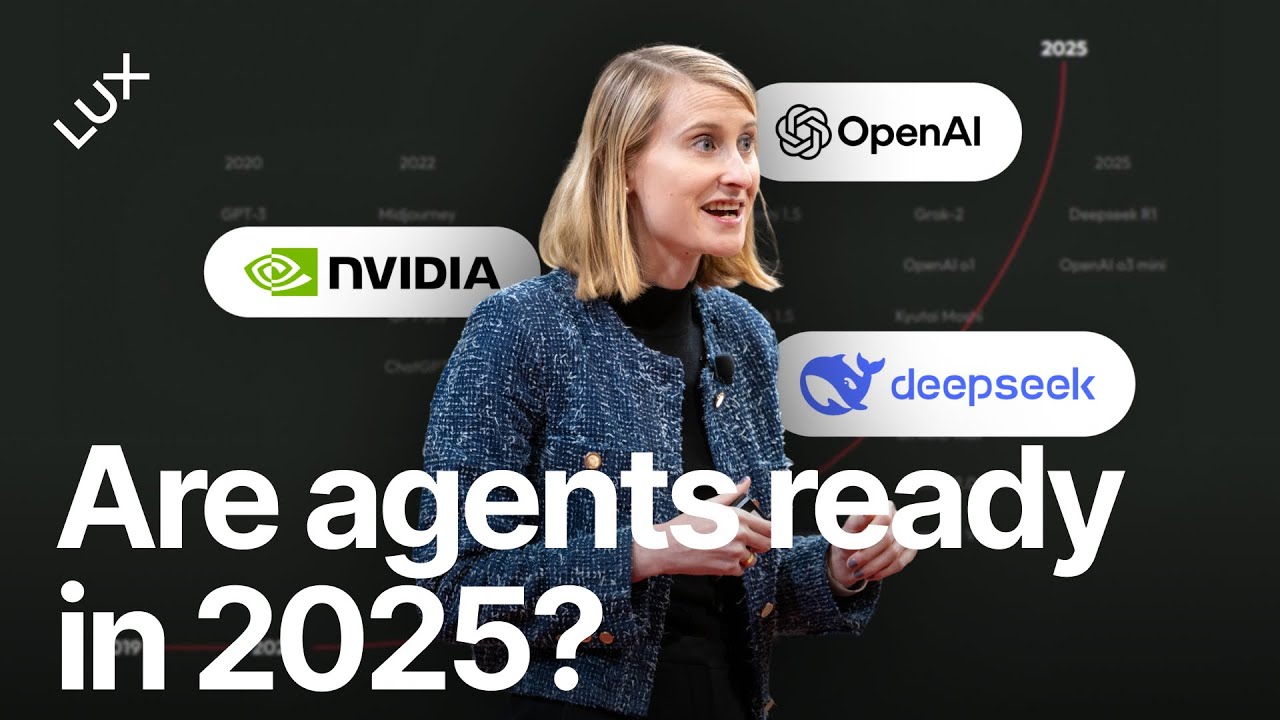
AI agents are improving because reasoning models, test-time compute, cheaper inference, and better hardware are arriving together, but fully autonomous systems still fail on ordinary tasks.
2
Small decision, integration, criteria, and preference errors compound across multistep and multi-agent workflows.
3
Grace Isford recommends better data curation, personal evaluations, error-containment scaffolding, workflow-specific user experience, and multimodal interfaces.
Summary
Grace Isford describes 2025 as a strong moment for AI agents, driven by reasoning models, test-time compute, cheaper inference, improved hardware efficiency, and large infrastructure investments. She is honest about the gap between that progress and reliable autonomous systems. A flight-booking example using OpenAI Operator fails because the system misses constraints, chooses poor routes, and cannot complete parts of the booking flow. These failures come from small errors in decisions, integrations, criteria, and user preferences. Across many steps, even high per-step accuracy can degrade badly. Isford recommends curating proprietary and user-generated data, building evaluations around personal preferences, adding scaffolding that contains failures and brings humans back when needed, and designing products around real workflows. She also argues that teams should move beyond chat interfaces and use voice, vision, touch, smell, memory, and robotics to create more personal systems.
The current model and infrastructure cycle creates favorable conditions for agents
Isford says AI progress has accelerated since Stable Diffusion appeared in August 2022. More companies are publishing capable models, including xAI, Mistral, and DeepSeek, while models are becoming more performant and compute-efficient. She points to reasoning models such as OpenAI's o1 and o3 and DeepSeek's R1, increased test-time compute, cheaper inference, improved hardware efficiency, and major infrastructure projects. Together, these developments create what she calls a perfect storm for AI agents. She adds that the expected breakthrough has not arrived yet: there has been plenty of momentum, but no decisive moment when autonomous agents reliably work.
An agent is a fully autonomous system whose LLM directs its own actions
Isford defines an AI agent as a fully autonomous system where large language models direct their own actions. She tests this idea with a flight-booking request sent to OpenAI Operator. The request includes a departure after 3 p.m., an attempt to avoid New York traffic, preferred airlines, a $500 budget, an aisle seat away from the bathroom, and an arrival before midnight. Operator first goes to Kayak and fails to find a flight. On a second attempt through Skyscanner, it finds a 5:30 p.m. JFK flight with difficult traffic and does not let her choose a seat. The example shows why an apparently simple task contains many hidden requirements.
Isford separates agent failures into several kinds. A decision error can send a traveler to San Francisco, Peru instead of California. An implementation error can come from a CAPTCHA or lost database access. A heuristic error can ignore the time needed to reach JFK, while a taste error can violate a personal preference such as avoiding a Boeing 737 Max. She also describes a perfection paradox: people expect magical results but become frustrated when an agent thinks too long, moves at human speed, or behaves inconsistently. In her example, a system with 99% accuracy per step falls to about 60% after 50 consecutive tasks, showing how multistep systems amplify small mistakes.
Data curation should include the information an agent creates
Isford's first strategy is data curation. Agent systems must work with messy, unstructured, siloed information across text, design, images, video, audio, sensors, and warehouses. Teams should also consider proprietary data, the data generated by the agent, and the data used to check workflow quality. She recommends designing a data flywheel from the start, so product use improves the system over time. For the flight example, that could mean storing Grace's airline preferences and her dislike of the 737 Max, then recycling the results of many bookings into a model of her changing preferences.
Evaluations need to reflect personal preferences and real use
The second strategy is evaluation. In areas such as mathematics and science, teams can often check whether an answer is right or wrong. Non-verifiable tasks are harder. A travel plan may be good for one person and poor for another. Isford uses competing deep-research products as an example: the best system depends on whether the work is everyday research, venture-market research, or academic research. Teams need to collect human preference signals and build evaluations around the intended user. Sometimes the most useful evaluation is trying the agent yourself and judging it against your needs rather than relying on a leaderboard.
Scaffolding can stop one agent failure from spreading
Isford's third strategy is scaffolding systems. When an applied AI feature fails, the surrounding infrastructure should prevent the error from cascading through the agentic system and production infrastructure. She cites Ramp as an example of a company that has built logic for this containment. Scaffolding can include a compound system that controls how components interact, as well as a human checkpoint. Stronger agents may detect their own mistakes and repair their path, while uncertain agents may need to pause execution. In the travel example, a checkpoint could verify traffic conditions before the system commits to a flight.
Workflow-specific user experience matters more as models become interchangeable
Isford calls user experience the missing factor that can turn agents into better co-pilots. Many AI applications use the same foundation models, so the product experience and its understanding of the user's workflow determine much of the difference. Deep Research can ask clarifying questions, and tools such as Windsurf can anticipate a developer's next step by understanding the developer's working style. Harvey integrates with legacy systems used by lawyers. Isford is especially interested in products with proprietary data and deep workflow knowledge in areas such as robotics, defense, manufacturing, and life sciences.
Multimodal products can move AI beyond the chatbot interface
Isford's final strategy is to build multimodally. She argues that AI products can become more personal by using eyes, ears, voice, smell, touch, embodiment, and memory. Lux has invested in Osmo, which is digitizing smell. Robotics can add physical interaction and a sense of embodiment. She is tired of the chatbot as the default interface and points to Tldraw as an example of rethinking the visual canvas, including its Jitter computer for combining AI models without exposing the language-model layer to the user. In her view, a compelling product vision can matter even when the underlying agent remains inconsistent.
"Sometimes the best eval is just trying out the agent yourself and vibes based on your needs with no number or leaderboard telling you what to do."12:20
Who should watch
You are building an agent that takes actions across several tools and need to understand why high single-step accuracy can still produce poor outcomes.
Your team is choosing evaluations for an agent whose answers depend on individual preferences or workplace context.
You are designing an AI product and want practical guidance on data flywheels, failure containment, workflow-specific UX, or interfaces beyond chat.