Curiosity helps engineers discover capabilities in models that are hard to predict in advance.
2
A demo is a practical way to explore a model and communicate a possibility, even when the implementation is incomplete.
3
AI engineers should revisit ambitious ideas from earlier computing work and share the demos they build.
Summary
Sharif Shameem argues that curiosity is the force that brings ideas from the future into the present. His examples include a browser-based JSX compiler built around GPT-3, an interface that generated application components through parallel prompts, an attempt to make GPT-3 buy AirPods, and newer video tools such as a basketball shot tracker using Gemini 2.5 Pro. Each demo began with an idea that seemed compelling, ran into severe model and context limitations, and became possible through practical experimentation. Shameem describes AI engineering as an excavation of capabilities hidden inside models. Demos help engineers explore those capabilities and help other people imagine products that are not obvious from model documentation. He also argues that current builders should return to ideas from computing pioneers such as J.C.R. Licklider, whose vision of a context-aware assistant remains only partly realized. Sharing demos is part of that work because it gives other people something concrete to extend.
Curiosity brings subconscious patterns into conscious ideas
Shameem opens with Henri Poincaré's account of a mathematical insight arriving as he stepped onto a bus after weeks of being stuck. He connects that sudden feeling to curiosity. His argument is that the brain notices patterns below conscious awareness, then surfaces them as a pull toward an idea. The same process guides his own demo work. He often starts with an idea that feels as if it could change everything, only to discover that the model and the implementation make it seem impossible. The effort of working through those limits can turn the idea into something usable.
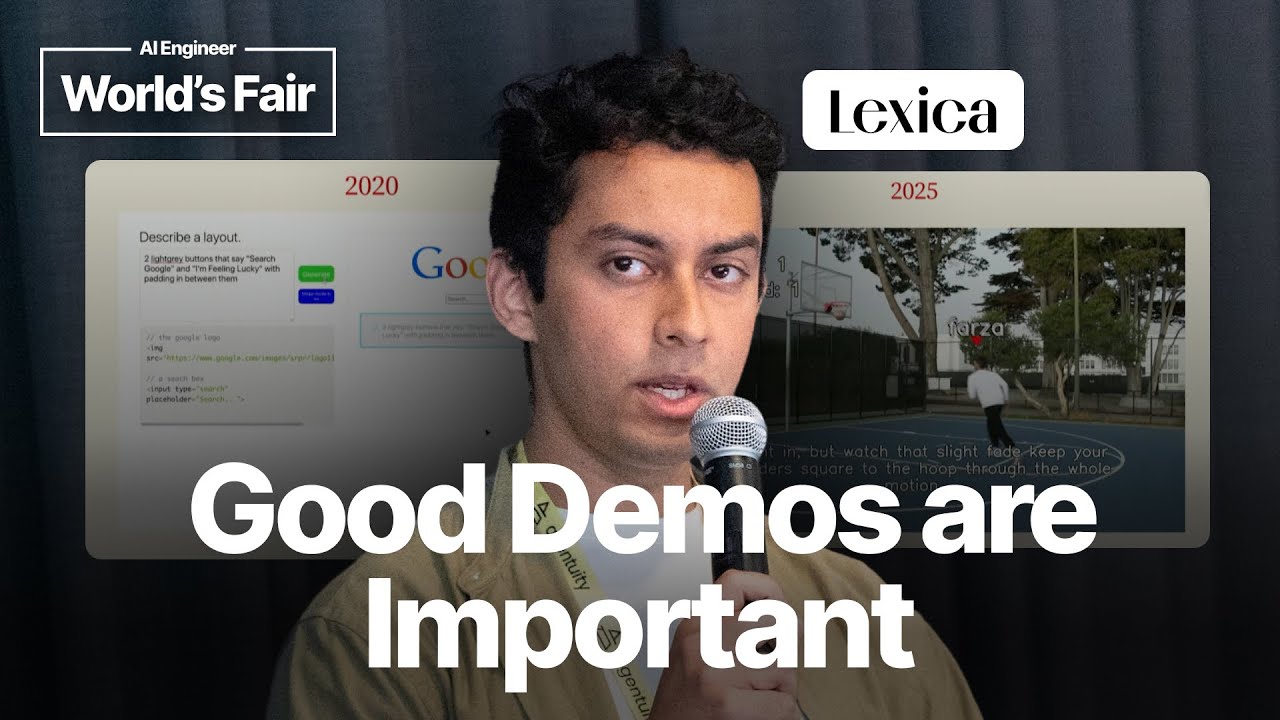
Shameem says models cannot always be understood by reading about them. People learn what they can do by interacting with them, and he sees interesting demos as one of the best ways to do that. His first example came after GPT-3 was released in 2020, when the model had a 2,000-token context length, cost $75 per million output tokens by his estimate, and had strict sharing restrictions. He combined it with a browser-based JSX compiler after being frustrated with copying code into an editor, compiling it, and running it. The result felt different from ordinary programming because it gave immediate feedback.
Small context windows turn product ideas into engineering problems
A later demo let someone describe a Google homepage and generated three components through three parallel prompts before joining them in the background. GPT-3 could not fit the whole application into one prompt, so the interface worked around its context limit. In another 2021 experiment, Shameem asked GPT-3 to buy AirPods in Chrome. A shopping page could contain about 24,000 tokens, far beyond the model's context window, so he wrote a custom HTML parser that reduced the page to its core information. The system failed, including by getting distracted by terms of service, but the attempt suggested that a model trained on web text could display a form of agency.
Shameem uses a friend's basketball shot tracker as a recent example. The system takes a video of the player and asks Gemini 2.5 Pro to give feedback as if Michael Jordan were watching. He says this helps people see that models can support video-first experiences, beyond the familiar example of watching a screen and commenting on code. He thinks there is still a great deal of unused capability in existing models. Even if model weights stayed frozen and training stopped, he argues that people could build impressive products for years by making demos and following their curiosity.
AI engineering is an excavation of unknown capabilities
Shameem quotes Richard Hamming: "In science, if you know what you're doing, you should not be doing it. In engineering, if you know what you're doing, you should not be doing it." He contrasts traditional engineering, which usually starts with a defined purpose, with AI engineering, where builders search for capabilities hidden inside models. A demo is the tool for that search, and curiosity is the flashlight that guides it. Even researchers at OpenAI and Anthropic, he says, have told him they did not know GPT-3 could browse the web or generate functioning React components. The limits of a model are therefore discovered through use.
Shameem compares exploration of models with Charles Darwin's eight years of studying barnacles. At the time, people thought Darwin might be wasting his time, but the work gave him evidence for his theory of evolution. Builders cannot always tell in advance whether an experiment is important or merely playful. A demo may seem to lead nowhere, then teach its creator something that becomes useful later. This is why he argues for making things even when the outcome is uncertain. The experiment itself can reveal a capability or a direction that was not visible at the start.
Model exploration has to proceed one experiment at a time
In 2025, Shameem describes model context windows as having grown from about 2,000 tokens to roughly a million. He still does not think the resulting possibilities can be planned in advance. He compares exploration to crossing a foggy pond by stepping onto one stone, checking where it leads, and backtracking when the path is uninteresting. A tweet he cites compares selling Claude as a coding model to selling an intergalactic spaceship as a toaster because one surface gets hot. The point is that people often focus on the obvious use while demos expose less apparent abilities.
Personal context creates ideas other people may not have
Shameem says each person has a unique context window made from their experiences. When someone notices a possibility through that personal background, they may be among the only people who have had the idea. He considers it a mistake to leave such ideas untested. This gives curiosity a practical responsibility: build enough to find out whether the idea works. He also connects uncertainty with discovery. If an engineer already knows exactly what they are doing, they may be repeating a known path rather than finding a new model capability.
Sharing demos connects current tools to older visions of computing
Shameem closes with J.C.R. Licklider's 1960s paper "Man-Computer Symbiosis." Licklider imagined an assistant that knew everything a person was working on and could help immediately. Shameem contrasts that vision with the experience of opening a new ChatGPT conversation that has little memory of earlier work. He says today's builders have a responsibility to do justice to ideas from computing pioneers, who had ambitious concepts but lacked today's tools. Sharing demos lets other people see what current models can do and gives those older ideas a chance to be rebuilt.
"Your unique perspective shouldn't be wasted, and I think you have a moral responsibility to share them with the world."10:58
Who should watch
You build prototypes with language or image models and need a way to choose which strange ideas deserve more time.
Your model experiments keep failing because of context limits, web-page size, or awkward interfaces, and you want examples of turning those limits into design problems.
You are looking for older human-computer interaction ideas that current models might make practical.