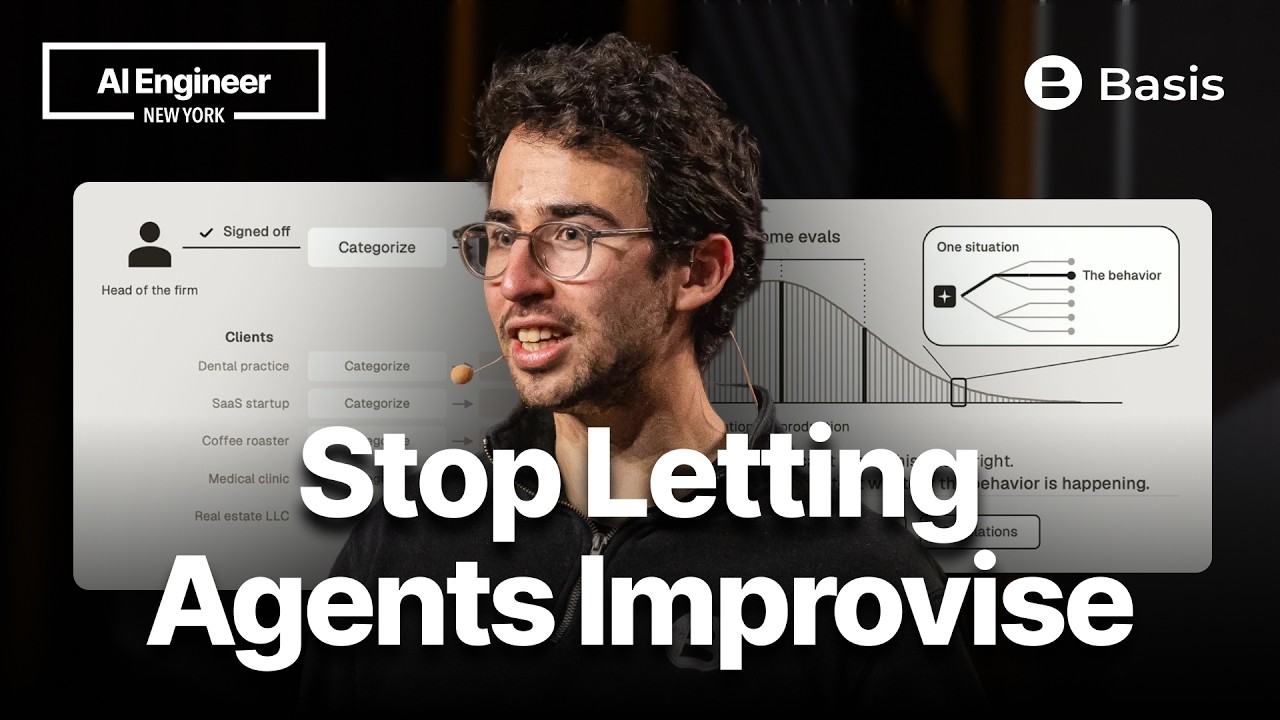
Individual engineers can become far more productive with AI while companies see little change because coding-style agents leave users to manage both the agent's complexity and the work process.
2
Production agents need opinions about how work should be done, because consistent behavior matters more than occasionally finding the best possible answer.
3
Behavior specs, forking, and sub-agent simulations give teams ways to supervise agent behavior when outcome-based evals cannot cover the full range of production situations.
Summary
Mitchell Troyanovsky argues that the large productivity gains engineers get from tools such as Codex and Claude Code do not spread through companies automatically. Organizations scale work through processes that let leaders trust outputs without knowing every detail of how the work happens. Coding-style agents create a competency gap because users must know how to direct them, and a process gap because each user can decide how the work gets done. Troyanovsky's answer is to make agents opinionated. Teams should define preferred behaviors, measure whether those behaviors occur, and accept that reliability may matter more than finding the theoretically best method every time. He describes behavior specs as concise statements of important intent, then explains how forking and sub-agent simulations help diagnose failures and test changes. The goal is an agent that starts with a narrow, dependable role and earns trust through predictable work, much like a coworker.
Companies scale intelligent work through processes rather than deterministic behavior
Troyanovsky uses accounting firms as an example of how organizations scale. A firm's leader may not know the day-to-day details of work at the bottom of the organization, but processes create confidence that the work will produce good outputs. The same applies to small tasks such as cash reconciliation. Staff are expected to use approved software to extract bank data rather than choose any method they want. The people are not deterministic, yet the process is intended to generalize to acceptable results.
Coding-style agents create both a competency gap and a process gap
Troyanovsky says current agent products leave too much responsibility with the user. Users must manage their own skills and memories, decide when to use the agent, and develop a theory of mind about how it will behave. Most knowledge workers will not know how to do that. At the same time, an agent that simply lets each user decide what to do creates a process gap. Organizations normally set processes from senior leadership downward, while coding-style agents let every employee customize the way work is performed.
Agents become easier to use when their behavior is opinionated
For an agent to feel simple and reliable, the user should not have to understand its internal choices. Troyanovsky says the agent needs opinions about how work should be done. Reading a PDF could involve a vision-language model, Python and OCR, an OCR provider, or several checking models. Asking an agent to extract a PDF without choosing a method may produce good results sometimes, but the process will vary. Opinions can come from expertise, such as reading a primary tax source before responding or taking a picture of a generated PowerPoint to catch formatting errors.
Reliability means repeating an acceptable approach, including when the agent cannot complete a task
Troyanovsky separates reliability from perfection. Humans make mistakes, and production agents will also fail. The important property is that the agent behaves in a similar way across cases. It should be consistently able to recognize when it cannot do something rather than unexpectedly succeeding once and missing a basic requirement later. Opinions can include tradeoffs such as latency. Taking a screenshot of every PowerPoint may reduce formatting errors, but a team may decide that the added delay is not worth it.
Outcome evals do not reveal enough about long production trajectories
A traditional outcome eval has a right answer or a rubric for judging the result. Production work may contain hundreds of thousands of situations, and longer agent trajectories create many more possible decisions. Teams cannot establish ground truth for every trajectory. Troyanovsky suggests checking whether an important behavior or opinion actually occurred instead. This does not prove that every result is correct, but it gives a scalable signal about whether the intended process is being followed.
Behavior specs record the few opinions that matter most
In the bank reconciliation example, Troyanovsky wants the agent to explain a difference rather than post an entry merely to make the books tie. The exact preference is subjective, but customers should not receive one treatment in one case and another treatment in the next. A behavior is governed by more than a system prompt. It can depend on progressive disclosures, tool descriptions, model training, and all the context available at runtime. A behavior spec records the most important intent and provides a rubric for checking whether the behavior was relevant and then exhibited.
Forking helps teams find the cause of a behavior failure
When a trajectory fails a behavior evaluation, the team can locate the decision that contradicted the behavior and fork the agent from that point. The fork can be asked why it made the decision, or the team can change the agent's context and observe whether the behavior improves. Troyanovsky compares this with copying an agent in Claude Code or Codex, while noting that recreating a complete cloud environment, database, prompts, and other state is difficult. Forking turns an evaluation signal into information that can guide changes to the agent harness.
Sub-agent simulations offer a cheaper way to test context changes
A coding agent can be asked to create a sub-agent that pretends to be the production agent. The simulation receives the system prompt, skills, rendered context, and a scenario, and it is told not to cheat. If it can recreate the behavior seen in an eval or production, the team can adjust the context and see whether the simulated agent changes its decision. Troyanovsky says this is less accurate than forking, but much cheaper and faster. He used the method for more than a year before building forking into Basis's internal systems.
Agents earn trust through narrow, predictable work
Troyanovsky compares agent adoption with how people judge a coworker's pull request. The amount of review depends on both the change itself and the reviewer's perception of the coworker's competence. A highly trusted person may receive less scrutiny for a small internal change, while an unfamiliar person gets more scrutiny for a core service change. Agents can follow a similar path. An agent can start with a narrow role, become easy to use and reliable, and gradually earn trust as its behavior improves.
"It's not about being perfect. Humans are not perfect. Nobody is looking for perfect. What you're looking for is reliability and consistency and trustworthiness."05:34
Who should watch
You are building agents for accounting, operations, or other company workflows and need them to behave consistently across many users.
Your outcome evals pass, but production failures are hard to explain because you cannot inspect every decision in a long trajectory.
You want practical ways to define agent behavior and test changes without recreating a full production environment every time.